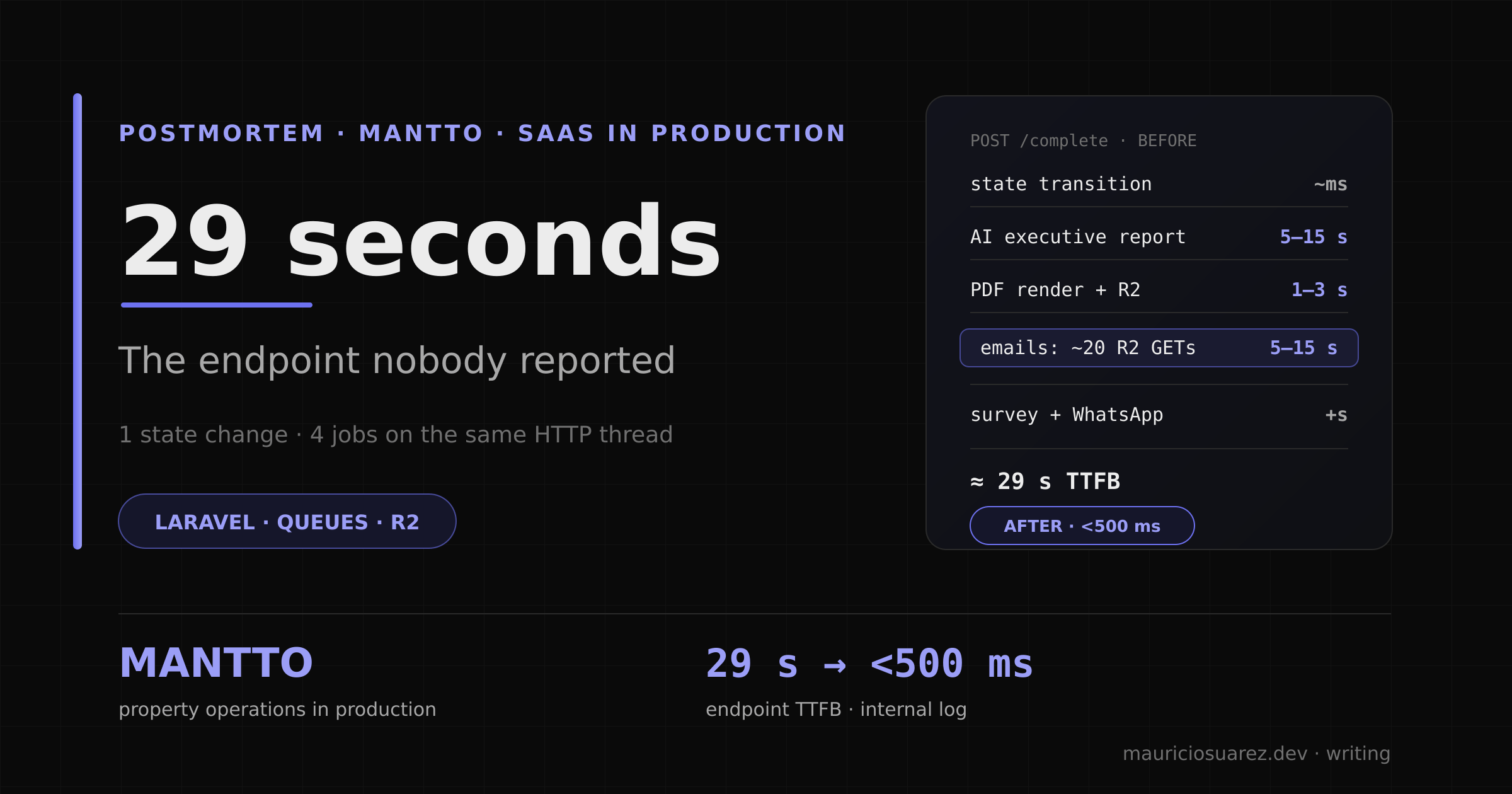
The most important endpoint in my SaaS took 29 seconds to respond. I know because I measured it — not because anyone reported it. Nobody ever complained. That silence is the most interesting part of this story.
The system is Mantto, a property maintenance and inspection platform running in production. The endpoint in question is the one that marks a maintenance request as completed: the button an administrator hits to close out the day. It sounds trivial. It isn’t.
The symptom nobody reported
POST /api/v1/maintenance-requests/{id}/complete was returning ~29 seconds of TTFB in production. The spinner spun for half a minute and the user waited, because “it’s generating the report” seemed like a reasonable explanation. The delay had become normal: when slow is how it’s always been, it stops being a bug and becomes a feature of waiting.
There was no ticket, no complaint. There was an internal measurement and a suspicion: no endpoint should take 29 seconds to update a status.
And why did it matter, if nobody complained? Because the complete button closes out the day: a half-minute spinner invites the second click — and with it, the risk of a duplicate record — and then the doubt about whether the work was saved at all. Normalized slowness trains people to distrust the system at the exact moment that matters most: when it certifies that a job is done.
The autopsy: four jobs on a single HTTP thread
Opening completeExecution() revealed the root cause: the state transition was only the first line. Everything else — the post-completion fan-out — ran synchronously inside the HTTP request:
| # | Job | Cost | Detail |
|---|---|---|---|
| 1 | AI executive report | ~5–15 s | OpenAI/Gemini call through the app’s AI gateway |
| 2 | PDF render + R2 upload | ~1–3 s | DomPDF renders the report and uploads it to Cloudflare R2 |
| 3 | Two confirmation emails | ~5–15 s | The hidden culprit — detail below |
| 4 | Satisfaction survey | seconds | Another synchronous email + WhatsApp |
The hidden culprit was #3. The confirmation emails attached the job’s evidence (before and after photos). The mailable’s build() did one R2 GET per attachment: with ~10 images × 2 recipients that’s ~20 sequential downloads from object storage, plus the synchronous Resend API call to send. All inside the original HTTP request, with no ShouldQueue.
There’s a delicious irony here: the WhatsApp notifications were already async from the start. The bottleneck wasn’t the AI or the PDF — it was the emails, the component nobody suspects because “an email can’t take 15 seconds.” It can. When an email is, in reality, an object-storage client in disguise.
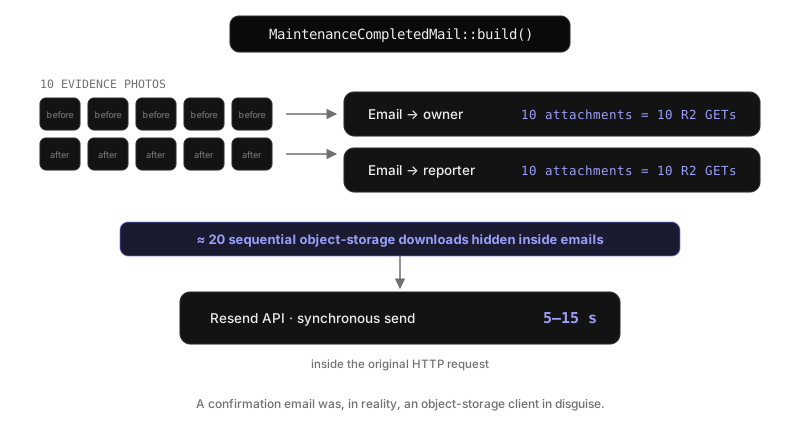
Anatomy of the hidden culprit: each email attached 10 photos, downloading them one by one from R2 — two recipients, ~20 sequential GETs — plus the synchronous send. All inside the original HTTP request.
The total: 29 seconds of legitimate work executed in the worst possible place.
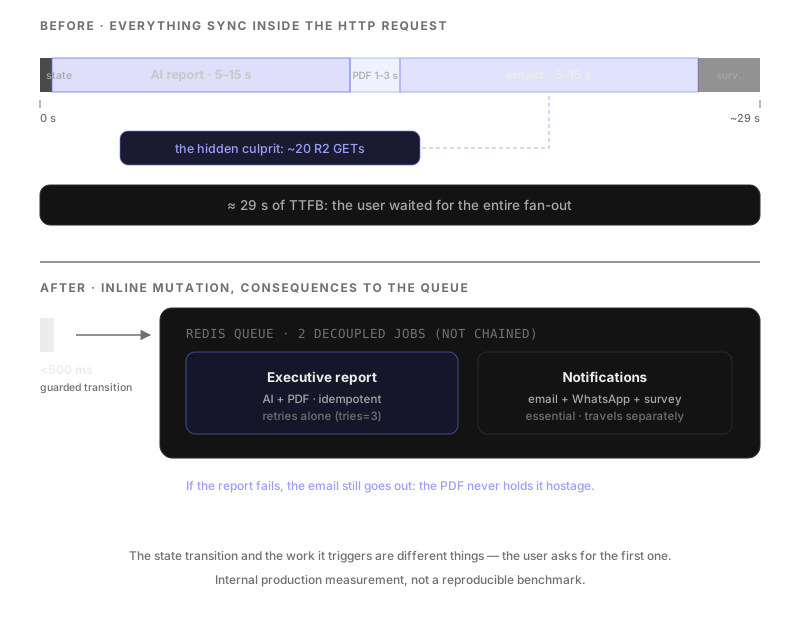
Top: the full autopsy. Bottom: the pattern that replaced it. On mobile, swipe the graphic horizontally to see it in full.
The fix: mutate fast, fan out later
The pattern I applied is old for good reason — do the state mutation inline, everything else goes to the queue — but the details are what decide whether it survives production:
1. Inline, only the guarded mutation. The state transition with its transaction and lockForUpdate, plus the fast database work that was already protected. Nothing else.
2. The mailables implement ShouldQueue. One interface, and the ~20 R2 downloads + the send migrate to the worker. Mail::to()->send() queues them automatically.
3. One job per concern, decoupled — not chained. I considered Bus::chain([reportJob, notifyJob]) and rejected it: if the report job retries (throws), the chain breaks and the email never sends. The email is essential; the PDF is a nice-to-have. Decoupled, the email proceeds on its own and the report retries independently (tries=3, idempotent — if one already exists, it skips). The notifications job even omits the PDF gracefully when the report isn’t finished yet.
4. The dispatch can fail too. The state change is already committed when the jobs are dispatched; if Redis happens to be down at that moment, the request must not crash or hide a completed state:
try {
    GenerateMaintenanceExecutiveReportJob::dispatch($mr->id, $user->id);
    SendMaintenanceCompletionNotificationsJob::dispatch($mr->id, $user->id);
} catch (\Throwable $e) {
    report($e); // for ops reconciliation; the manual backstop is
                // the admin "regenerate report" endpoint
}
return $maintenanceRequest->refresh();
The result: the endpoint responds in <500 ms. The ~29 seconds of work still exist — they now run on the Redis queue, where they belong.
The gotchas, in short
The change surfaced three traps no tutorial mentions (keep them if you apply the pattern):
Mail::assertSentstops working the moment the mailable implementsShouldQueue:Mail::fake()records it as queued — you needMail::assertQueued(...).- Jobs dispatched in tests were running on the REAL queue:
phpunit.xmlsetsQUEUE_CONNECTION=syncvia<env>, but<env>does not populate$_SERVER— the container’srediswins, fakes don’t apply insidehandle(), and one test ended up uploading to real R2 (~22 s per test). Robust pattern:Queue::fake()+assertPushed()without execution, or instantiate the job and callhandle()directly. - Deploying with Octane:
docker compose restart api worker(it caches config/middleware) +php artisan queue:restart— without this, you dispatch jobs no worker knows about yet.
What transfers
- Silence isn’t health, it’s normalization. I measured because I distrusted the spinner, not because something failed. “It’s always been this slow” is the most expensive sentence in a SaaS.
- The state transition and the work it triggers are different things. The user asks for a state change; the report, the PDF and the emails are consequences. Consequences don’t need to block the confirmation.
- Chain only what is truly sequential. An elegant
chaincan cost you the essential email because of the optional PDF. Essential and nice-to-have travel separately. - Emails are code. I/O in
build()is I/O in your request. Every attachment is a network download you pay for in latency — or in the queue. - Protect what’s already committed. If the state was saved, a failure to dispatch the consequences is a reconciliation incident, not a 500 for the user.
Two pieces of honesty before closing: the 29 s → <500 ms is an internal production log, not a reproducible benchmark (a single operator, low volume at the time — part of the lesson is that the pain doesn’t need volume to exist). And the solution didn’t invent anything: it respected a pattern Laravel gives away and applied discipline at the edges.
Epilogue with a hook: weeks after this fix, another AI call — this one with a timeout — taught me that some errors no try/catch can catch, because the process is already dead when they happen. That’s the next entry in this series.